

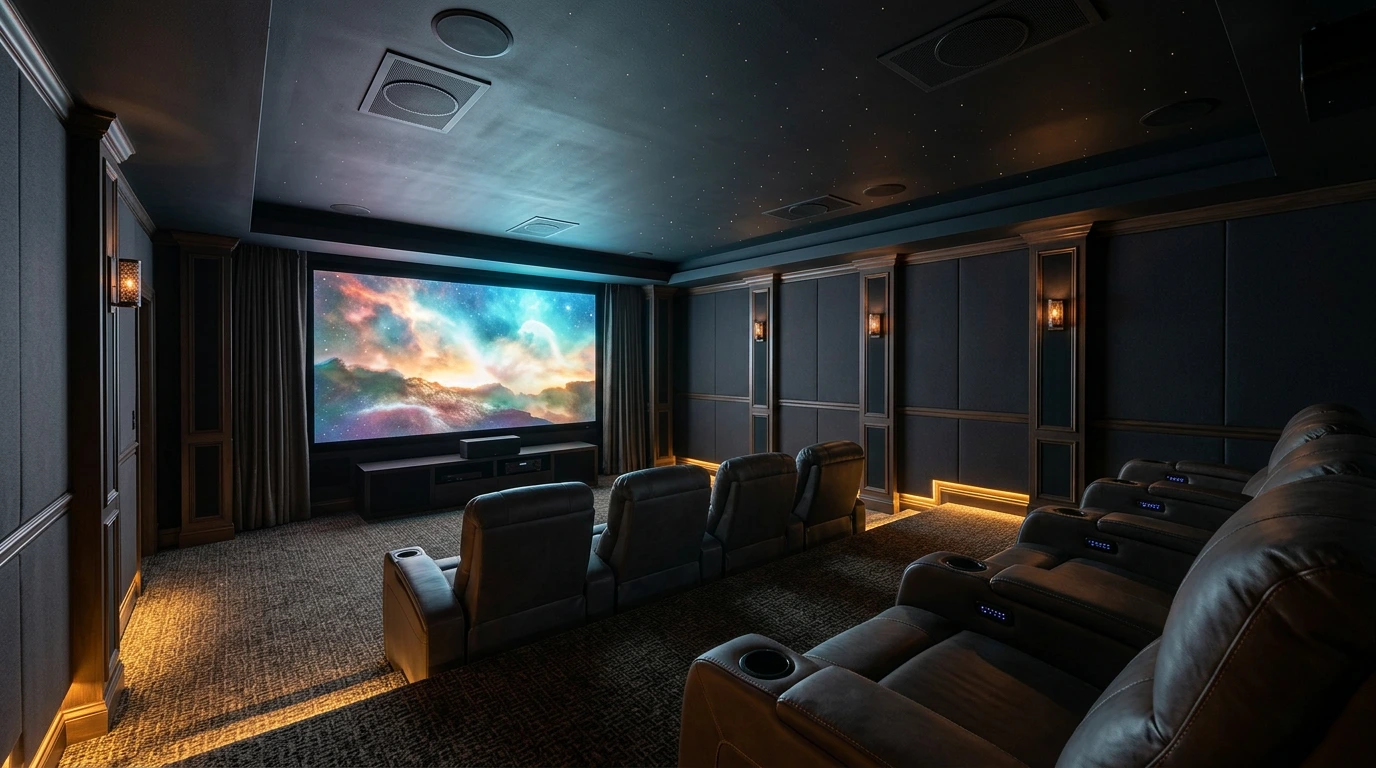
Dolby Atmos adds a layer of height to surround sound, so effects move above you as well as around you. Its layouts are written as three numbers - like 5.1.2 or 7.1.4 - where the first is the ear-level speakers, the second the subwoofers, and the third the height/overhead speakers that make it "Atmos". A 5.1.2 is a great starting point for most rooms; 5.1.4 and 7.1.4 add more channels for a bigger, dedicated cinema. The height speakers (in-ceiling or up-firing), the right AV receiver, good acoustics, and proper calibration are what turn a speaker list into a genuinely immersive room.
Dolby Atmos is what makes a home cinema feel like you're inside the film rather than in front of it - rain falling from above, a jet passing overhead. But "5.1.2", "7.1.4," and overhead-speaker talk can be confusing. This guide explains the Dolby Atmos speaker layout and setup clearly, so you can plan a room that actually delivers the effect.
What is Dolby Atmos?
Regular surround sound places you in the middle of speakers arranged around you, at ear level. Dolby Atmos adds a height layer - overhead sound - and treats effects as "objects" that can move anywhere in three dimensions, including above you. The result is a far more enveloping, realistic sound field. To get it, you need speakers overhead (or that fire upward), a receiver that decodes Atmos, and a room set up to suit. If you're starting from scratch, our guide to building your first home theatre sets the foundation.
Understanding the Numbers: 5.1.2 and 7.1.4 Explained
This is the part most people find confusing, and it's actually simple. A Dolby Atmos layout is written as three numbers, X.Y.Z:
- First number (X) — the ear-level speakers: left, centre, right, and the side/rear surrounds.
- Second number (Y) — the subwoofers, for bass.
- Third number (Z) — the height/overhead speakers dedicated to Atmos.
So 5.1.2 = five ear-level speakers + one subwoofer + two height speakers. 7.1.4 = seven ear-level + one subwoofer + four height. The third number is the one that makes a system "Atmos" — without height speakers, it's just surround sound.
Dolby Atmos Speaker Layout by Configuration
Which configuration suits you depends on the room and budget:
- 5.1.2 — the popular entry point. Five ear-level speakers, a sub, and two height speakers. Ideal for most living rooms and smaller media rooms.
- 5.1.4 — adds two more height speakers (four total) for a more convincing overhead effect; great for a dedicated room.
- 7.1.4 — adds two more surround speakers (seven ear-level) plus four height; a fuller, more enveloping sound bubble for a larger cinema.
- 7.2.4 and beyond — dual subwoofers for even bass across a bigger room, with the full height array.
Bigger isn't automatically better - a configuration beyond what the room can support won't help. Match the layout to the space and seating.
Height & Overhead Speakers: In-Ceiling vs Up-Firing
The height layer is the heart of Atmos, and there are two ways to achieve it:
- In-ceiling / ceiling-mounted — overhead speakers fixed into or onto the ceiling. These give the most accurate, convincing height effect because the sound genuinely comes from above. The premium choice for a dedicated cinema, and best planned during construction so wiring is concealed.
- Up-firing — speakers (or modules on top of your main speakers) that fire sound upward to bounce off the ceiling. A clever option when you can't install ceiling speakers — a rented or finished room - but they rely on a suitable flat, reflective ceiling and are usually a little less precise.
For a luxury home cinema, we favour discreet in-ceiling speakers; our guide to hidden speakers for luxury homes shows how they disappear into the room.
Speaker Placement Principles
Beyond the configuration, placement decides how good it sounds. The broad principles: the front three (left, centre, right) anchor the screen; surrounds go to the sides and rear at roughly ear level; height speakers are positioned in front-and-rear pairs above and slightly ahead of/behind the main seating; and everything is aimed at the primary listening position. Exact angles and heights follow Dolby's guidelines and the room's dimensions - which is why professional placement and calibration matter so much. Our guide to home theatre speaker placement covers the fundamentals.
Beyond Speakers: Receiver, Acoustics, Calibration & Wiring
A Dolby Atmos system is more than speakers:
- AV receiver/processor — it must support Atmos and have enough channels for your layout; see what an AV receiver is and how to choose one.
- Acoustics — the room changes everything; hard, bare rooms sound harsh. Treatment makes a bigger difference than most people expect, as we explain in how acoustics change the way your speakers sound.
- Calibration — levels, distances, and timing tuned to the room are what unlock the effect; a great system badly calibrated disappoints.
- Wiring & infrastructure — overhead speakers especially need cabling planned early, ideally during construction.
Planning a Dolby Atmos Room in India
In Indian homes, a few things matter: the room (a dedicated space gives the best result, but a well-designed living room can do Atmos too), ceiling height and type for overhead speakers, acoustics, and professional installation to get placement and calibration right. For budgeting, see our home theatre cost guide, and for the full luxury treatment, our private home cinema work.
How We Build Dolby Atmos Home Cinemas
We design and install Dolby Atmos home cinemas end to end - choosing the right configuration for the room, planning overhead-speaker wiring early, treating the acoustics, selecting and calibrating the receiver and speakers, and integrating it all so a single "Movie" scene dims the lights, drops the screen, and starts the sound together, as covered in our home cinema lighting and scene control. Explore our home theatre and audio-video services.
If you want a true Dolby Atmos cinema designed and calibrated properly, book a consultation with TechVault.
FAQs
What do the numbers in Dolby Atmos (5.1.2, 7.1.4) mean?
Dolby Atmos uses a three-number naming convention. The first number is the ear-level speakers (left, centre, right, and the side/rear surrounds), the second is the subwoofers for bass, and the third is the height or overhead speakers that create the sense of sound above you. So 5.1.2 means five ear-level speakers, one subwoofer, and two height speakers; 7.1.4 means seven ear-level speakers, one subwoofer, and four height speakers. The third number is what makes it "Atmos".
What is the best Dolby Atmos speaker configuration for a home?
There is no single best - it depends on the room size and budget. A 5.1.2 is a great entry point for most living rooms; 5.1.4 or 7.1.4 add more surround and height channels for a bigger, more enveloping effect in a dedicated cinema. Larger rooms benefit from more channels (and sometimes dual subwoofers, e.g. 7.2.4). The right configuration is the one matched to the room and seating, which is best decided with a professional.
How many speakers do you need for Dolby Atmos?
The minimum for a home Dolby Atmos system is usually a 5.1.2 - that is, eight speakers in total (five ear-level, one subwoofer, and two height/overhead). From there, you can scale up to 5.1.4, 7.1.4, and beyond for larger, dedicated rooms. The two (or more) height speakers are the essential part that separates Atmos from regular surround sound.
In-ceiling vs up-firing Dolby Atmos speakers - which is better?
In-ceiling (or ceiling-mounted) overhead speakers generally give the most accurate, convincing Atmos height effect, because the sound comes from directly above. Up-firing speakers, which bounce sound off the ceiling, are a clever option when you cannot install ceiling speakers (for example, in a rented or finished room), but they depend on a suitable flat ceiling and are usually a little less precise. For a dedicated home cinema, in-ceiling is the premium choice.
Do I need a special AV receiver for Dolby Atmos?
Yes. You need an AV receiver (or processor) that supports Dolby Atmos and has enough channels for your chosen configuration - a 5.1.2 needs a receiver that can drive at least seven channels plus height, and 7.1.4 needs more still. The receiver decodes the Atmos soundtrack and sends each sound to the right speaker. Our guide to AV receivers explains how to choose one.
Can Dolby Atmos be integrated into home automation?
Yes. In an integrated smart home, a single "Movie" scene can start the Atmos system, dim the lights, close the blinds, and drop the screen together, with one touch. Running the cinema on an open standard like KNX means the sound, picture, and room work as one - which is how a professionally designed home cinema is meant to feel.