

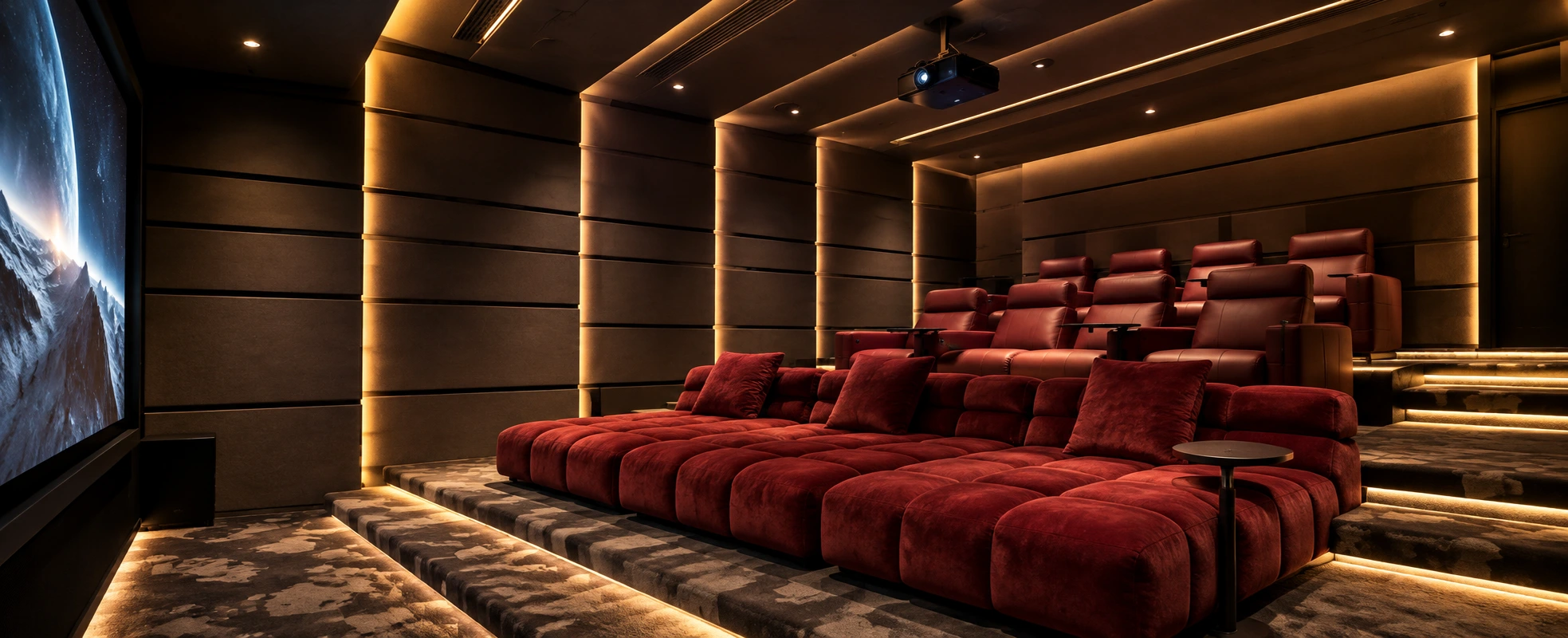
Most home theatres are a collection of good equipment in an ordinary room. A truly immersive one is the opposite: a room designed, from the start, so that the moment the film begins, the room disappears, and you are inside the story. That difference is not about buying a bigger projector — it is about planning the whole space as one experience. This guide is about that planning: how to design the room, the seating, the immersive sound, and the big-screen video together, so the result is genuine immersion, not just a big TV in a dark room.
What "immersive" actually means — and why planning decides it
Immersion is a specific feeling: the room around you falls away, and your senses are fully inside what you are watching. It is the difference between watching a film and being in it. And it does not come from any single component — it comes from several things working together so well that nothing reminds you that you are sitting in a room.
Three elements create immersion, and all three are planning decisions, not shopping decisions:
- A picture that fills your view — a large-format screen or projection, sized and placed so the image occupies enough of your field of view to pull you in
- Sound that surrounds and places you — audio coming from around and above you, so sounds sit in the right place in space, not just from the front
- A room that protects the illusion — controlled light, managed reflections and acoustics, and seating placed in the sweet spot, so nothing breaks the spell
If you plan the equipment but not the room, you get an expensive setup that still feels like a TV on a wall. If you plan all three together, you get immersion. That is why this is a design exercise first. For the component-level basics — projector types, resolution, screens, sound tiers — our complete guide to building your first home theatre is the companion to read alongside this.
Start with the room, not the equipment
The single biggest mistake is choosing equipment first and forcing it into whatever room is left over. Immersion starts with the room, because the room decides how much control you have over everything else.
When planning the space, think about:
- Light control — immersion needs darkness on demand; a room you can make fully dark (or a dedicated, windowless room) beats a bright one with the best projector
- Shape and proportions — the room's dimensions affect both the screen size you can use and how sound behaves in it
- Isolation — keeping sound in (and the rest of the house out) matters for both immersion and not disturbing others
- Dedicated vs shared — a dedicated room gives the deepest immersion; a well-planned media or living room can still be immersive with the right design
A dedicated, light-controlled room will always give the most complete result — this is what a private home cinema is built around. But the principle holds either way: decide and design the room first, then bring the equipment to it.
Design the seating around the screen and sound
Seating is where immersion is won or lost, and it is the part most setups neglect. You can have a perfect screen and perfect sound, and still break the experience by putting the seats in the wrong place. Seating is not furniture you add at the end — it is a core part of the design.
Plan seating around two things: the picture and the sound.
- Viewing distance — seats placed so the screen fills your view comfortably: close enough to be enveloping, not so close it strains, not so far it feels small
- The sound sweet spot — seats positioned within the area where the surround sound comes together properly, so the audio places you correctly
- Sightlines — for more than one row, a raised rear platform so every seat sees the full screen, not the heads in front
- Comfort for the long haul — immersion means sitting through a whole film, so genuinely comfortable recliners matter, not just their placement
Getting the geometry right — where the seats sit relative to the screen and speakers — is what turns good equipment into a genuinely immersive experience.
Immersive sound: the half people underrate
Here is a truth that surprises people: sound carries more of the immersion than the screen does. The picture shows you the scene, but it is the sound that places you inside it — the rain overhead, the footsteps behind you, the bass you feel in your chest. A spectacular screen with weak, front-only sound always feels flat; strong, well-placed sound lifts the entire experience.
Immersive sound means audio from around and above you, not just the front — so sounds occupy their correct position in three-dimensional space. Planning for it involves deciding the speaker layout for the room, positioning speakers (including overhead) correctly, and getting the room's acoustics right so the sound is clean rather than muddy. Our guides to home theatre speaker placement, how acoustics change the way your speakers sound, and what an AV receiver does go deeper on each.
The takeaway when planning: give the sound equal weight to the screen, and plan them together. Do not spend everything on the picture and leave the audio as an afterthought — it is half of the immersion.
The big-screen picture
The visual side is the other half — and immersion here is about scale and quality filling your view. The choice is usually between a projector with a large screen and a large direct-view display, and it is made for the specific room, its light control and its size.
Key planning decisions:
- Projector vs display — a projector and large screen gives the biggest, most cinematic image for a controlled room; our guide to projector vs ultra-short-throw covers the options
- Screen size to seating — the screen sized to the room and the viewing distance, so it fills the view without overwhelming it
- A proper screen, not a wall — a real screen surface gives a far better image than bare paint
- Light control again — the picture is only as good as the room's darkness allows, which is why the room came first
Plan the picture and the room together — the same decision, really — and the visual half of immersion falls into place.
The things people forget: lighting, infrastructure and air
Three practical elements quietly make or break an immersive theatre, and they are the ones most often left out of planning.
- Lighting — not just darkness, but designed theatre lighting: soft step and aisle lighting, bias lighting behind the screen to ease the eyes, and scenes that dim smoothly as the film starts. Our guide to home theatre lighting and bias/cove scenes covers this.
- Infrastructure — the wiring and conduit for speakers, screen and sources, and the power for it all, planned into the build. This is far cleaner done during construction than retrofitted, and it is exactly what gets forgotten until it is expensive to fix.
- Air and cooling — a sealed, dark room full of electronics and people gets warm and stuffy. Ventilation or cooling has to be planned in, or the immersion ends the moment the room becomes uncomfortable.
None of these are glamorous, but skipping them is what separates a theatre that feels professionally done from one that feels improvised.
Tie it together with automation
Finally, the detail that protects everything you have planned: the theatre should be effortless to use. Immersion breaks the instant you are fumbling with three remotes to start a film. Automation keeps the experience seamless.
With integration, a single "movie" action can dim the lights to the right level, lower the screen, start the projector, and set the sound — and bring the lights gently back up when the film ends. The whole room responds as one, so the only thing you do is press play. This is where a theatre stops being equipment you operate and becomes an experience you step into — and it is exactly how we design it. Our home theatre and wider home automation work builds the theatre and its control as one system.
We design and plan immersive home theatres across Delhi NCR — the room, seating, sound, picture, lighting and automation as one experience, matched to your space and how you watch.
Two ways to start:
- Book a consultation → contact us
- Call us directly: +91-94148-16207
FAQs
What makes a home theatre "immersive"?
Immersion is when the room disappears, and you feel inside the film. It comes from three things working together: a large-format picture that fills your field of view, surround sound that places audio around and above you, and a room designed so nothing — light, reflections, seating sightlines — breaks the illusion. A single great component does not make a theatre immersive; the design of the whole room does.
How do I plan the seating for a home theatre?
Seating is planned around the screen and the sound. Seats are placed at a viewing distance where the screen fills your view comfortably, centred so most seats get a good head-on view and sit within the surround-sound sweet spot. For more than one row, a raised rear platform keeps sightlines clear. Comfortable recliners matter too, because immersion means sitting for a whole film. Seating should be planned with the room, not added last.
What do I need to plan during construction for a home theatre?
The infrastructure behind the walls — wiring and conduit for speakers, the screen or projector, and sources; power planned for the equipment; and ventilation or cooling for a sealed, windowless room full of electronics and people. These are far cleaner to build in during construction than to retrofit, so plan them early with your integrator, alongside the room and acoustics.
Is immersive sound more important than the screen?
Both matter, but sound carries more of the immersion than people expect. A large screen gives you the picture, but surround and overhead sound is what places you inside the scene — rain above you, a car passing behind you. A great screen with weak sound feels flat, while strong immersive sound lifts the whole experience. Plan them together, and do not under-invest in the audio.
Do I need a dedicated room for an immersive home theatre?
A dedicated, light-controlled room gives the most immersive result, because you can control light, sound isolation, seating, and speaker placement fully. But a well-designed living-room or media-room setup can also be immersive with the right planning. The more control you have over the room, the deeper the immersion — so the room itself is the first decision, not the equipment.
Should an immersive home theatre be automated?
Yes — automation is part of the immersion. A single "movie" action can dim the lights, lower the screen, start the projector and set the sound, so nothing breaks the mood with fiddling. Lighting scenes, blackout, and the AV all respond together. A theatre you have to operate manually, remote by remote, works against the very immersion you built it for.