

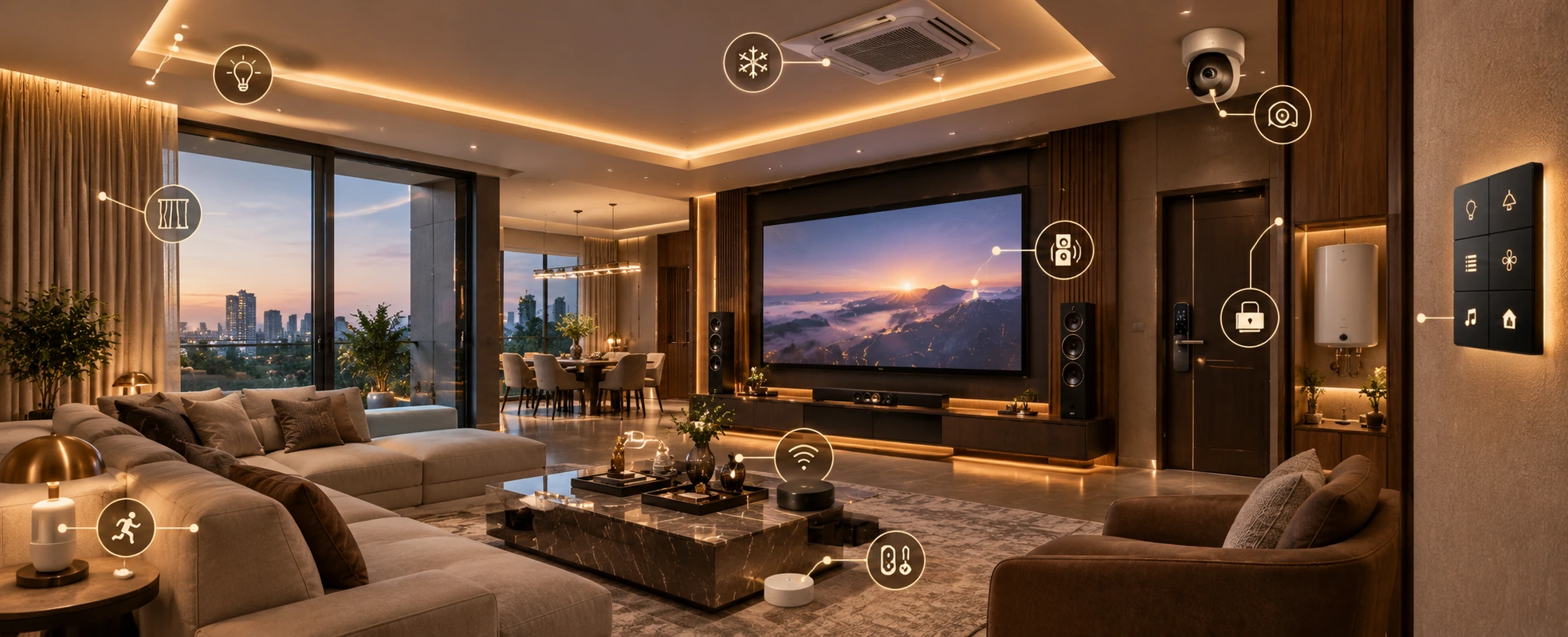
The top 10 smart home devices in 2026 are smart switches and keypads, smart lighting control, climate and AC control, motorised curtains, home theatre and audio, smart locks and entry, CCTV cameras, sensors, smart geyser control, and the hub that ties them together. But the most important thing to know is that these devices are worth far more connected than alone: a home where they all work as one system — with scenes, one control and devices that respond to each other — is a true smart home, while the same devices bought separately are just gadgets. This is the list, and how to make them work as one.
First, the one rule that matters most
Before the list, the single most important point: the best smart home is not the one with the most devices — it is the one where the devices are connected and work together. You can buy every device on this list and still have a frustrating home if each has its own app and none speak to each other. Connected as one system, the same devices become genuinely smart — one command, scenes that move many devices at once, and a home that responds as a whole.
Read the list with that in mind. Each device below is useful on its own, but its real value comes from being part of one integrated system. For the fundamentals, our complete guide to home automation is a good starting point.
1. Smart switches and keypads
The first step into a smart home for most people, and the device you touch every day. Instead of one switch per light, an elegant keypad can control lights, fans, scenes and more — and the same controls work from an app or by voice. They replace a cluttered wall of switches with something clean and considered. See our complete guide to smart switches and KNX keypads.
2. Smart lighting control
Where automation delivers the most visible daily value. Beyond on/off, smart lighting means dimming, warmth control, zones and scenes — a room bright for work, warm and low for relaxing, or set for a film, all without hunting for switches. Fine control is often built on protocols like DALI. Our guides to smart lighting automation and what to know before installing lighting go deeper.
3. Smart climate and AC control
In India, one of the most valuable devices of all — because AC drives both comfort and the electricity bill. Smart climate control brings cooling into the automation: managed by room, held at comfortable levels, scheduled, coordinated with curtains, and set back when rooms are empty. It is comfort without the remotes, and less energy wasted cooling empty rooms.
4. Motorised curtains and blinds
Underrated until you live with them. Beyond opening and closing at a touch or on schedule, they manage daylight, privacy and heat — shading against the sun reduces the load on the AC. Our guides to how curtain automation works and how curtains and AC should work together explain more.
5. Home theatre and multi-room audio
The entertainment heart of a smart home. Whether a dedicated cinema or multi-room audio through the house, these are far better integrated — a single "movie" scene sets lighting, sound and screen together. Our audio-video and home theatre services, and our guide to building your first home theatre, cover this.
6. Smart locks and entry
Security and convenience at the front door. A smart lock and a video door phone let you secure and control entry, see and admit visitors from anywhere, and manage access for family and staff. Our digital locks service and video door phone buyer's guide cover the options.
7. CCTV and security cameras
The eyes of the home. Cameras covering the entrances, perimeter and key areas, viewable from anywhere, are a core device for peace of mind — and best when part of the same system as the rest of the home. Our guide to how smart security systems detect suspicious activity and our security and surveillance service cover this.
8. Sensors
The devices that make a home automatic rather than just controllable. Motion and occupancy sensors switch lighting and climate based on whether a room is in use; other sensors watch conditions like air quality — so the home responds on its own. Our guides to smart motion sensors and air quality sensors explain their role.
9. Smart geyser and water heater control
A small device with a daily payoff, especially in an Indian winter. Bringing the geyser into the automation means it heats before your bath time so hot water is ready, switches off automatically so it stops wasting power, and can be turned on from your phone — ending both the wait and the "did I switch it off?" worry. A geyser is one of the most power-hungry appliances in a home, so controlling when it runs matters.
10. The hub or controller: the brain
The most important of all. The hub — or controller — connects and coordinates every other device and makes them work as one system. It routes a single command to the right device, runs your scenes, and gives you one place to control everything. Without it, devices stay islands; with a reliable controller, often on the open KNX standard, they become a genuine smart home. Our guide to smart home hubs explains why the brain matters most.
What about smart bulbs, robot vacuums and other gadgets?
An honest note. Plenty of standalone gadgets — plug-in smart bulbs, robot vacuums, portable assistants — are marketed as smart home devices, and they can be handy conveniences. But they are not a smart home system, and a drawer full of disconnected gadgets, each with its own app, is exactly what this list is not about. A real smart home is built on a proper foundation — the devices above, working together on a reliable system — and can bring other gadgets into it. Start with the system; add conveniences to it.
How to choose: don't buy the list, design the home
You do not need all ten devices on day one. The smarter approach is to decide what matters most to you — often lighting, switches and climate — and build on a system that connects them, so each device you add joins one home rather than becoming another island. What makes these devices worth it is the integration, not the quantity.
That is how we approach every smart home: designed around how a family lives, built on a reliable backbone, and grown over time — so the devices work as one. We design integrated home automation across Delhi NCR. Our home automation service is where it all comes together, and if you are building or renovating, planning it in early makes everything cleaner.
FAQs
What are the top smart home devices in 2026?
The core ones are smart switches and keypads, smart lighting control, climate and AC control, motorised curtains, home theatre and audio, smart locks and entry, CCTV cameras, sensors, smart geyser control, and the hub or controller that ties them together. The controller matters most, because it is what makes the other devices work as one connected system rather than separate gadgets.
Do I need all ten devices to have a smart home?
No. You can start with what matters most to you — often lighting, switches, and climate — and add more over time. What matters is building on a system that connects them, so each device you add joins one home rather than becoming another island with its own app. The value is in the integration, not the number of devices.
Which is the most important smart home device?
The hub or controller — the brain of the home. It connects and coordinates every other device, runs your scenes, and gives you one place to control everything. Individual devices are only as smart as the system that ties them together, so a reliable controller (often on the open KNX standard) is what turns a collection of devices into a genuine smart home.
Are smart bulbs and robot vacuums smart home devices?
They are consumer conveniences that can be part of a smart home, but on their own they are not a smart home system. A real system is built on a proper foundation — integrated switches, lighting, climate, security, and a reliable controller — and can bring other gadgets in. Buying disconnected gadgets is not the same as having an integrated smart home.
What is the best smart home device for saving energy?
Climate and AC control and smart geyser control are two of the biggest, because air conditioning and water heating are among the most power-hungry things in an Indian home. Managing when they run — cooling only occupied rooms, heating water only when needed — reduces waste. Lighting control and sensors add further savings by ensuring nothing runs when it does not need to.
How do I get started with smart home devices?
Decide what matters most to you, and build on a system that connects your devices rather than buying gadgets separately. It is best planned as part of a home's automation — ideally during a build or renovation — so the devices work together on a reliable backbone. An integrator can design it around how you live and let it grow over time.