

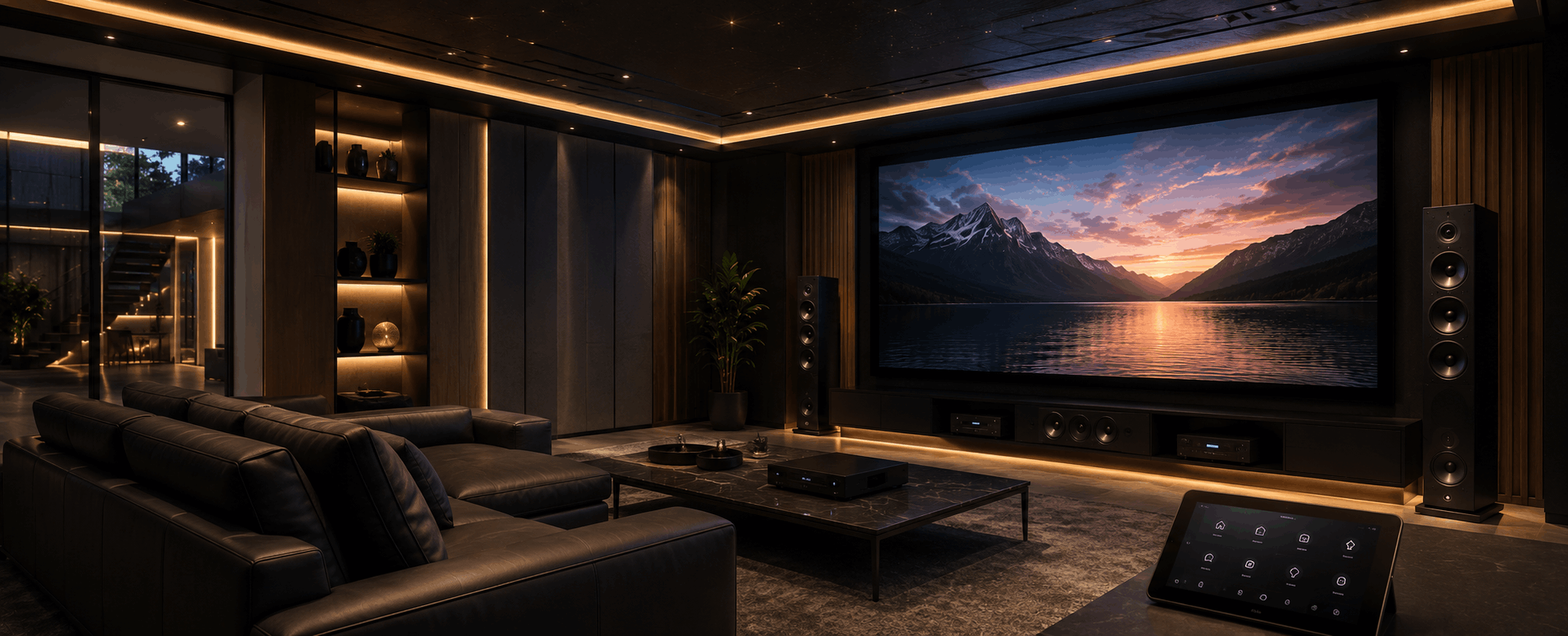
An audio-visual system is an integrated setup of displays, speakers, sources, and controls that delivers sound and picture together as one coordinated system. The individual pieces — a screen, a set of speakers, an amplifier — aren't what make it an AV system. What makes it one is that they're designed to work together and operate from a single point of control.
At TechVault, we design and install AV systems as part of KNX-integrated homes and buildings across Delhi NCR, Noida, Gurgaon, and Jaipur. This guide covers what an AV system actually includes, how requirements differ between a home and an auditorium, what it costs in India, and why integration matters more than any individual component.
What Does an AV System Actually Include?
Most AV systems are built from four layers. Miss any one, and the result underperforms regardless of how good the equipment is.
| Layer | What It Covers |
|---|---|
| Video | Displays, projectors, screens, video walls, mounting |
| Audio | Speakers, subwoofers, amplification, processing |
| Control | Keypads, app, voice — the single point everything responds to |
| Infrastructure | Cabling, signal distribution, network, rack |
The layer people forget is control. It's the difference between owning good equipment and owning a system — and it's the one that decides whether the room actually gets used.
What Does "AV Room" Mean?
An AV room is a space where audio and visual equipment is permanently installed and calibrated to work together as one system.
In a home, that usually means a dedicated home cinema. In a school or office, it means an auditorium or conference room with projection, sound reinforcement, and control. What separates an AV room from a room that happens to have a TV is that every component is integrated and responds to a single command rather than being operated separately.
What Are the Different Types of AV Systems?
The category covers several quite different things, and knowing which one you're actually planning changes every decision that follows.
Type | Where | Priority |
|---|---|---|
| Home theatre | Dedicated room in a house | Cinematic experience, surround accuracy |
| Multi-room audio | Across a whole home | Even coverage, zone control |
| Conference room AV | Offices | Reliable video calls, one-tap operation |
| Auditorium AV | Schools, colleges, corporate | Even sound to every seat, visibility |
| Banquet and event AV | Hotels, venues | Flexible reconfiguration |
| Digital signage | Retail, lobbies | Content scheduling, brand consistency |
A conference room and an auditorium are both "AV", but almost nothing about their design is shared.
Audio-Visual Systems for the Home
Residential AV in India has moved well past a television in the living room.
What a home AV system typically covers:
- 4K displays or laser projection with motorised screens
- Dolby Atmos surround sound using in-ceiling and in-wall speakers
- Multi-room audio across living areas, bedrooms and terrace
- Outdoor audio for gardens and terraces
- Control integrated with lighting, curtains and climate
Where it's used:
Dedicated home theatre — a purpose-built room with acoustic treatment, tiered seating and a large-format display or projector.
Multi-room audio — different music in different zones, all controlled from one place.
Living room AV — a well-integrated display and audio setup where the equipment doesn't dominate the room.
Outdoor AV — weather-rated speakers for terraces and gardens, usually as an extension of the multi-room system.
For placement specifics, see our guide on home theatre speaker placement. For the receiver decision, our guide to AV receivers covers what it does and what it costs.
Audio-Visual Systems for Auditoriums
Auditoriums are the most technically demanding AV projects, because sound has to reach every seat evenly and visuals have to be clear from the back row.
Core components:
- Line array speaker systems for even distribution across a large space
- Digital mixing and audio processing
- Large-format LED walls or high-lumen projection
- Confidence monitors for presenters
- Integrated lighting and AV control for one-touch event scenes
Design considerations: room dimensions, ceiling height, reflective surfaces, and seating arrangement all influence the design. A poorly designed auditorium system produces dead zones where audio is inaudible and hot spots with excessive volume — proper design avoids both.
For institutional projects specifically, see our detailed guide on school and college auditorium AV systems. Our guide to line array speaker systems explains the audio approach in more depth.
Audio-Visual Systems for Offices and Commercial Spaces
Commercial AV is judged on something different from residential: whether staff who didn't install it can operate it reliably, months later, under time pressure.
Meeting and conference rooms — display, ceiling microphones, camera, and a control panel that starts a call with one press.
Corporate auditoriums and town hall spaces — larger scale, presenter audio, recording and streaming.
Hotel banquet halls — flexible zoning for events that change format week to week.
Retail and showrooms — zoned audio and display walls for brand consistency.
Our guide to commercial AV integration covers offices, hotels and auditoriums in detail.
How Does KNX Change AV System Integration?
A standard AV system, however good the equipment, still needs separate control for lighting, climate, and audio-video — multiple remotes, multiple apps. KNX brings AV into the same scene logic as everything else.
| Without KNX Integration | With KNX Integration |
|---|---|
| Separate remote for AV, separate app for lighting | One keypad press triggers AV, lighting, and blinds together |
| Manual setup for each mode — movie, music, presentation | Pre-programmed scenes activate instantly |
| AV isolated from climate and security | All systems coordinated — AC adjusts, blinds close, lights dim |
| Multiple control points across rooms | A single Basalte or ABB keypad controls the whole system |
In a KNX-integrated home theatre, the projector, screen, audio processor and lighting all belong to one "Movie" scene — pressed once, executed in under two seconds.
This is the difference between AV as a collection of products and AV as part of a building. Our guide to how KNX works explains the underlying mechanism.
What Does an Audio-Visual System Cost in India?
| Project Type | Approx. Cost |
|---|---|
| Basic living room AV — display, soundbar, smart control | ₹80,000 – ₹2,00,000 |
| Multi-room audio — 3 to 5 zones | ₹1,50,000 – ₹6,00,000 |
| Home theatre with Dolby Atmos and 4K projection | ₹3,00,000 – ₹15,00,000+ |
| Conference or meeting room | ₹2,50,000 – ₹10,00,000 |
| School or institutional auditorium | ₹5,00,000 – ₹25,00,000+ |
| Large auditorium or multi-hall venue | ₹25,00,000 – ₹1,00,00,000+ |
Indicative estimates covering equipment, installation, and commissioning. Actual cost depends on room size, seating capacity, brand selection, and the depth of integration with lighting and building systems.
For a full breakdown of home theatre specifically — including what the automation layer adds — see our home theatre cost guide.
What Should You Plan Before Installation?
The decisions that are difficult to reverse once surfaces are finished:
- Speaker cable routes — in-wall and in-ceiling speakers can't be cabled after the ceiling closes
- Display and screen positions — including power and signal cabling at the mounting point
- Rack location — AV equipment needs a ventilated space with network access
- Signal distribution — how sources reach displays across rooms
- Acoustic treatment — planned with the layout, not added afterwards
- Control integration points — where AV needs to talk to lighting and climate
Retrofitting AV cabling into a finished space typically costs considerably more than running it during construction, and limits where equipment can go.
What's the Most Common Mistake?
Buying equipment before designing the room.
A high-specification system in an untreated room with poorly placed speakers routinely underperforms a modest system that was properly designed. Room acoustics and placement affect the result more than brand tier does — which is why we'd rather assess a space before recommending anything.
The second most common: treating control as an afterthought. A system nobody can operate confidently is a system that doesn't get used.
FAQs
What is an audio-visual system?
An integrated setup of displays, speakers, sources, and control that delivers sound and picture together as one system. What makes it a system rather than a collection of equipment is that the components are designed to work together and operate from a single point of control.
What is the difference between AV equipment and an AV system?
Equipment is the individual products — a screen, speakers, an amplifier. A system is those products designed, installed, and calibrated to work together, with unified control. The same equipment can perform very differently depending on whether it was integrated properly.
What does an AV system cost in India?
Basic living room AV starts around ₹80,000. A home theatre with Dolby Atmos ranges from ₹3,00,000 to ₹15,00,000 or more. Conference rooms typically run ₹2,50,000 to ₹10,00,000, and institutional auditoriums start around ₹5,00,000 and scale with seating capacity.
Do I need professional AV integration, or can I set it up myself?
For a basic display and soundbar, self-installation is fine. For anything involving in-wall speakers, surround calibration, multiple zones, or integration with lighting and climate, professional design and commissioning usually make a substantial difference to the result.
How is a KNX-integrated AV system different from a standard one?
In a KNX system, AV components are programmed into the same scene logic as lighting, climate, and blinds. One keypad press or voice command activates all of them together, rather than requiring a separate remote for each system.
Can an AV system be added to a finished building?
Partly. Displays, freestanding speakers, and control panels retrofit reasonably well. In-wall and in-ceiling speakers, concealed cabling, and full integration usually need access above a false ceiling or a renovation where surfaces are already being opened.
What matters more - the equipment or the room?
The room, more often than people expect. Acoustics and placement affect what you actually hear more than brand tier does. A well-designed room with mid-range equipment routinely outperforms premium equipment in an untreated space.
Planning an Audio Visual System?
Whether it's a home theatre, a conference room or an auditorium, the right system depends on the space, how it will be used, and how deeply it needs to integrate with everything else in the building.
Talk to our team for a site assessment and an itemised estimate, or explore our audio-video, home theatre and auditorium services.