

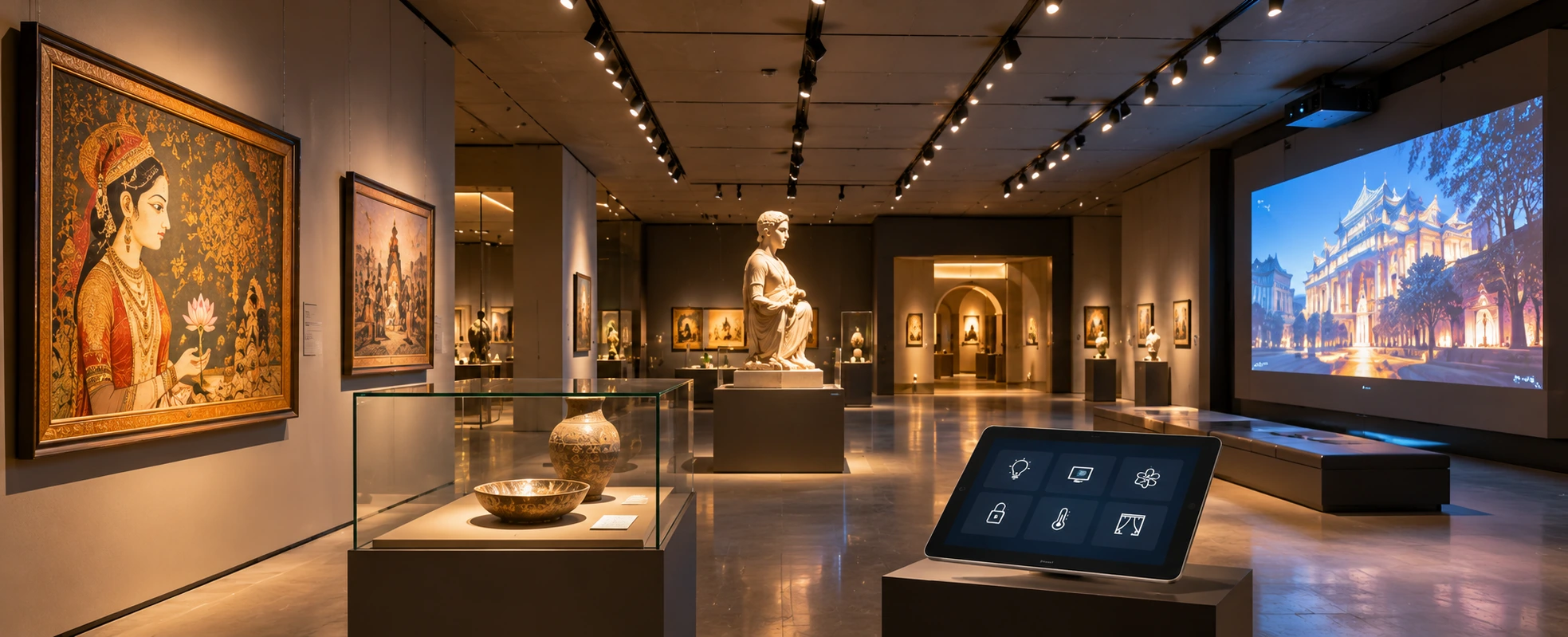
Museum, gallery and exhibition automation brings lighting, AV, environmental control and security onto one system - so exhibits are lit beautifully and protected from damage, visitors are engaged by reliable AV, sensitive conditions like temperature and humidity are monitored, and the whole space runs on simple scenes ("Open Hours", "Guided Tour", "After Hours") instead of a dozen separate controls.
A museum or gallery has an unusual brief: it must show its collection off and protect it at the same time. The lighting that makes a painting glow is also the light that can fade it. The space has to feel effortless to visitors while staff quietly manage conditions, security and events behind the scenes. Automation is what makes both possible at once.
This guide covers how lighting, AV, environmental control and security come together for museums, galleries and exhibition spaces in India.
Conservation Grade Lighting
Lighting is the heart of a gallery - and the biggest risk to its contents. Automated, fully dimmable lighting lets curators set precise levels for each exhibit, with low-heat LED fixtures and controlled intensity to limit the cumulative light exposure that fades pigments, paper and textiles over time.
With DALI-based control, every fixture can be addressed and dimmed individually, and tunable-white luminaires let you match colour temperature to the work on display. Lighting can also dim or switch off automatically during closed hours to reduce exposure. Flexible track systems suit spaces where displays change often - see our guides to DALI lighting control and architectural and track lighting.
Audio-Visual That Tells the Story
Modern exhibitions are experiences, not just objects on walls. Exhibition AV brings them to life: interactive touch displays, projection and projection mapping, zoned audio and audio guides, and digital signage for wayfinding and information.
The key is reliability and simplicity - systems that run all day without a technician, and that staff can start and stop with one touch. Because the AV sits on the same control platform as the lighting, a single scene can bring up a display zone's lighting and its media together. For larger halls and multi-purpose spaces, our work on AV for large venues and government AV and lighting covers related ground.
Environmental Control - Protecting the Collection
This is where cultural spaces differ most from other venues. Sensitive artifacts need stable temperature and humidity, and an automation system can monitor these conditions through a building management system, logging them and alerting staff when readings drift outside safe ranges. Tying HVAC and monitoring into the same platform means conditions are managed proactively rather than noticed too late. (See BMS and HVAC control.)
Security and Access
A collection's value makes security central. A well-designed system layers access control for restricted zones and back-of-house areas, surveillance, and alarm sensors - integrated so they work with scenes and schedules rather than as separate systems. An "After Hours" mode can arm zones, set security lighting and log access in one action. The right mix depends on the collection and the building; our guide to access control systems explains the fundamentals.
One System, Simple Scenes
The advantage of putting lighting, AV, environment and security on one KNX platform is that the whole space runs on scenes anyone can use:
- "Open Hours" — gallery lighting to display levels, AV zones live, climate at daytime setpoints.
- "Guided Tour" / "Event" — accent lighting on featured works, event AV and audio active.
- "After Hours" — lighting reduced, security armed, exposure minimised, monitoring continuing overnight.
Planning an Automation System for a Cultural Space
The best results come from planning lighting, AV, environment and security together at the design or renovation stage — one control layer, shared scenes, coordinated cabling. Retrofit is possible too, using wireless KNX RF where opening walls isn't an option.
As a KNX-certified integrator, TechVault designs these systems as one coordinated platform rather than separate installations. If you're planning a museum, gallery or exhibition space in Noida, Delhi NCR, and Gurugram or elsewhere in India, talk to our team for a requirement study.
FAQs
Why do museums and galleries need special lighting?
Museum and gallery lighting has to do two jobs at once: present each exhibit beautifully and protect it. Automated, dimmable lighting with low heat and controlled intensity lets curators highlight artwork precisely while limiting the light exposure that can damage sensitive pieces over time.
How does automation protect artwork and artifacts?
Beyond careful lighting, an automation system can monitor temperature and humidity through a building management system and alert staff to conditions that threaten sensitive artifacts. Lighting can also be scheduled to reduce exposure during closed hours, and sensors can flag unusual activity.
Can exhibition lighting and AV be controlled together?
Yes. On a KNX-based system, lighting, AV and shading share the same scene logic, so an "Open Hours", "Guided Tour" or "Event" scene can set gallery lighting levels and start exhibit audio or displays together, from one interface.
What AV is used in museums and exhibitions?
Common exhibition AV includes interactive touch displays, projection and projection mapping, zoned audio and audio guides, and digital signage. The goal is to engage visitors and tell a story, with reliable systems that staff can run easily and that integrate with the building's control.
How is security handled in a gallery or museum?
Security combines access control for zones and restricted areas, surveillance, and alarm sensors, integrated so that scenes and schedules work together — for example an "After Hours" mode that arms zones, adjusts lighting and logs access. The right mix depends on the collection's value and layout.
Can an existing museum or gallery be upgraded without major construction?
Often yes. Wireless KNX RF and retrofit options can add scene-based lighting control, AV and monitoring to an existing space with limited disruption, though a wired system is ideal when planned during a renovation. A site assessment confirms what's practical for the building.