

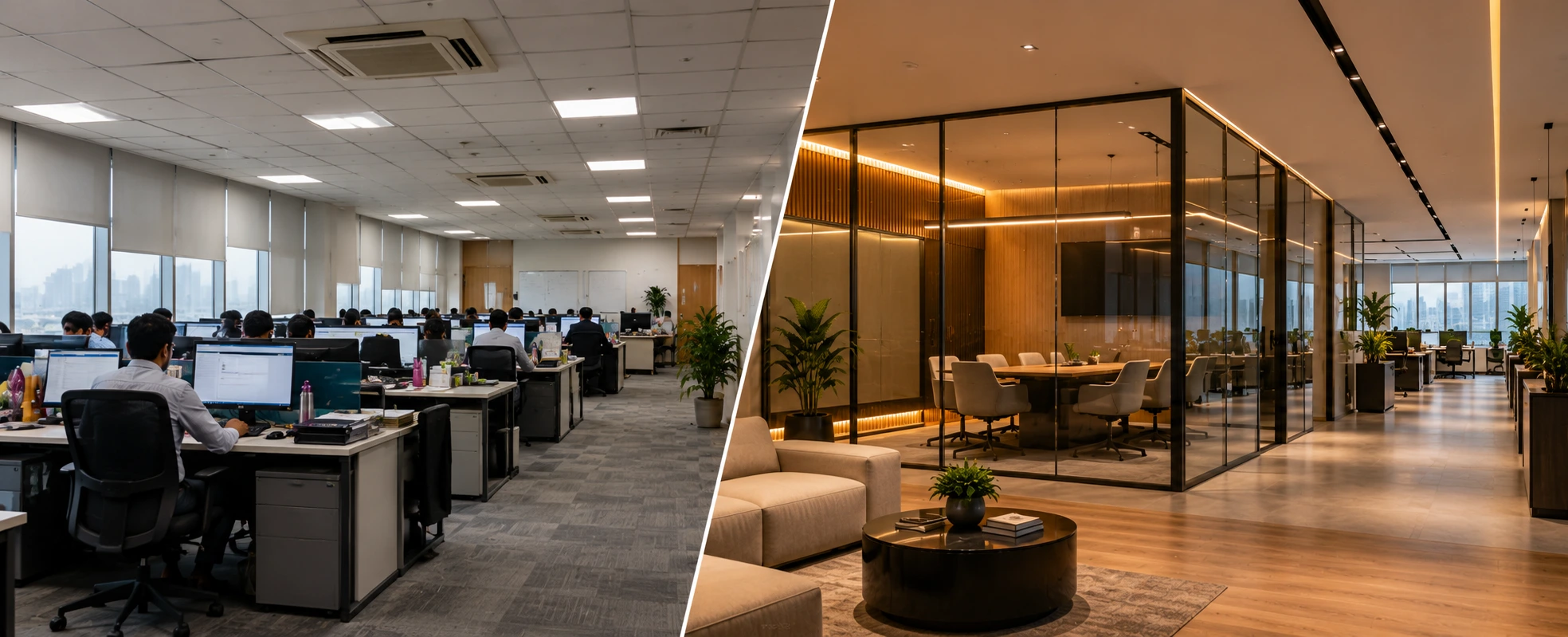
A traditional office runs on manual, separate systems - switches for lights, remotes for AC, keys for access, standalone meeting-room gear. A smart office connects these into one automated, centrally managed system: lighting and climate respond to occupancy, access and security integrate, meeting rooms start with one tap, and a dashboard monitors everything. The differences show up as lower energy costs, higher productivity and comfort, stronger security and easier management; a smart office costs more to set up but less to run, and it simply works better day to day.
Every office does the same basic things - light the space, cool it, secure it, run meetings. The question is whether it does them manually, system by system, or intelligently, as one connected whole. That is the real difference between a traditional office and a smart one. This guide compares the two side by side and lays out the benefits, so you can decide what makes sense for your workplace.
What is a Traditional Office?
A traditional office is one where the building's systems are operated manually and independently. People switch lights on and off by hand (and often leave them on in empty rooms), set air conditioning with remotes or a central timer, manage access with keys, cards, or a register, and set up each meeting room's standalone equipment. Nothing talks to anything else, and no one has a single view of how the building is running.
It works - but it leans on people to do the right thing, wastes energy, and gives little visibility or control.
What is a Smart Office?
A smart office connects those same systems into one automated, centrally managed whole. Lighting and climate respond to occupancy, schedules, and daylight; access control, cameras, and alarms are integrated and manageable remotely; meeting rooms start with one tap and tie into room booking; and the whole building can be monitored and controlled from a dashboard or app. For the full picture, see our complete guide to smart office automation and what goes where when planning one.
The point is not gadgets — it is a workplace that largely runs itself, efficiently and reliably.
Smart Office vs Traditional Office: Key Differences
| Feature | Traditional Office | Smart Office |
|---|---|---|
| Lighting | Manual switches; often left on | Automated — occupancy & daylight-based |
| Climate (AC) | Manual remotes / fixed timer | Smart, zone-based, scheduled |
| Energy use | Higher waste, little visibility | Optimised and monitored |
| Access & security | Keys, cards, registers | Integrated access control, cameras, remote |
| Meeting rooms | Standalone, manual setup | One-tap AV, room booking |
| Control | Separate systems | Centralised dashboard/app |
| Maintenance | Reactive (fix when it breaks) | Monitored, proactive |
| Running cost | Lower upfront, higher ongoing | Higher upfront, lower ongoing |
| Experience | Static | Responsive, comfortable, efficient |
In short: a traditional office is operated; a smart office is orchestrated.
Benefits of a Smart Office
The differences above translate into concrete benefits:
- Lower energy costs. Lights and AC run only when and where needed — the single biggest, most measurable saving, explored in BMS lighting control and HVAC control for commercial buildings.
- Higher productivity and comfort. Good lighting, stable climate, and meeting rooms that just work remove daily friction for staff.
- Stronger security. Integrated access control, cameras, and alarms, manageable remotely.
- Easier management. One dashboard for the whole building, with proactive maintenance instead of reactive repairs — on a reliable network backbone.
- Better meetings. Conference room automation and AV that start in one tap.
- Sustainability. Measurable reductions in energy waste that support ESG and cost goals alike.
For a wider view of where the workplace is heading, our guide to workplace automation benefits and trends goes further.
Is a Smart Office Worth It?
The honest trade-off is upfront investment versus long-term value. A smart office costs more to set up, but typically less to run — and it improves the daily experience in ways a traditional office cannot. For a new fit-out, designing it smart from the start is far cheaper than retrofitting later. For an existing office, upgrades can be staged — lighting and climate first, then access, security and management — so the investment is spread over time. Whether and how far to go depends on the size of the office and your priorities, which is exactly what a site assessment clarifies.
How TechVault Approaches Smart Offices
We design offices as connected systems, not collections of devices — lighting, climate, access, security, meeting-room audio-visual, and management working as one on reliable open standards like KNX, controlled from a single dashboard. Whether it is a new fit-out or a staged upgrade of an existing office, the goal is a workplace that is efficient to run, pleasant to work in, and simple to manage. Explore our office automation service for more.
If you are planning or upgrading an office, the best first step is a conversation about your space and how your teams work. Book a consultation to plan a smart office that fits your business.
FAQs
What is the difference between a smart office and a traditional office?
A traditional office runs on manual, separate systems — switches for lights, remotes for AC, keys and registers for access, and standalone meeting-room equipment. A smart office connects these into one automated, centrally managed system: lighting and climate respond to occupancy and schedules, access and security are integrated and remotely manageable, meeting rooms start with one tap, and everything can be monitored and controlled from a dashboard or app. The difference is between a building you operate manually and one that largely runs itself efficiently.
What are the main benefits of a smart office?
The main benefits are lower energy costs (lights and AC run only when and where needed), higher productivity and comfort (better lighting, climate and meeting-room experiences), stronger security (integrated access control and cameras), easier management (centralised monitoring and control, proactive maintenance), and sustainability (measurable reductions in energy waste). Together, they improve both the running cost and the daily experience of the workplace.
Is a smart office more expensive than a traditional office?
A smart office usually costs more to set up because it involves automation systems and integration, but it typically costs less to run thanks to energy savings and more efficient operation — so the comparison is upfront investment versus long-term value. For a new fit-out, designing it smart from the start is far cheaper than retrofitting later. The right spend depends on the size of the office and scope, which a site assessment clarifies.
Can a traditional office be converted into a smart office?
Yes. Many offices are upgraded in stages — starting with lighting and climate automation or meeting-room AV, then adding access control, security and centralised management over time. Wireless and retrofit-friendly solutions make it possible without a full renovation in many cases. A site assessment is the reliable way to know what is practical in a specific building.
Does a smart office actually save energy?
Yes — because lighting, air-conditioning, and other systems operate only when and where they are needed, rather than running in empty rooms, a smart office cuts the energy that a traditional office typically wastes. Combined with monitoring that reveals where energy goes, and features like daylight-based lighting, the savings are both real and measurable, which is one of the strongest reasons businesses upgrade.
Is a smart office worth it for a small business?
It can be. Even a small office benefits from automated lighting and climate, better meeting-room technology, and integrated security — and you can start small and expand. The key is to build on a system that can grow, rather than buying disconnected gadgets. Whether it is worth it depends on your space and priorities, which is best assessed for your specific office.