

An AV integration company designs, wires, and calibrates a luxury home's audio and video—home cinema, multi-room music, TVs, projectors, and their controls—as one system on a shared infrastructure, and ties it into the home's automation so everything runs from a single app or scene. Integration, not the equipment brand, determines how the system performs and whether it stays invisible.
In a luxury home, the sound and picture are rarely the hard part. The hard part is making a cinema, music in every room, televisions, projectors, speakers, and their controls behave like one calm, invisible system — instead of a collection of boxes installed room by room, each with its own remote and its own tangle of wires.
That is the job of audio-video (AV) integration, and of the company you trust to deliver it. This guide explains what an AV integration company actually does, the services a luxury home needs, how home cinema and multi-room audio come together, how AV ties into KNX automation, and how to choose the right partner. If you want the fundamentals of what an AV system is first, our complete guide to audio-video systems covers the basics — this article picks up where that leaves off, specifically for high-end residences.
What Is an AV Integration Company?
An AV integration company designs, wires, and commissions a home's audio and video systems so they work as one, rather than selling and fitting individual products.
The distinction matters. Buying a great home cinema is easy to assume is mostly about buying great equipment — but equipment is only as good as the infrastructure and design behind it. An integrator is responsible for everything around the hardware: the cable routes planned before the walls close, the equipment rack sized and ventilated correctly, the network that carries video and control signals, the speaker positions worked out against the room's acoustics, and the final calibration that tunes it all to the space.
Get those right and even modest equipment can sound and look superb. Get them wrong and premium gear disappoints — not because the boxes are bad, but because nothing was designed to work together. That is why, for a luxury home, choosing how the system is integrated matters more than any single product on the spec sheet. A true integration company takes responsibility for the whole system and its result, not just a parts list.
AV Integration Services for Luxury Homes
A luxury residence usually needs several AV systems designed and delivered as one. A full-service AV integration company brings these together:
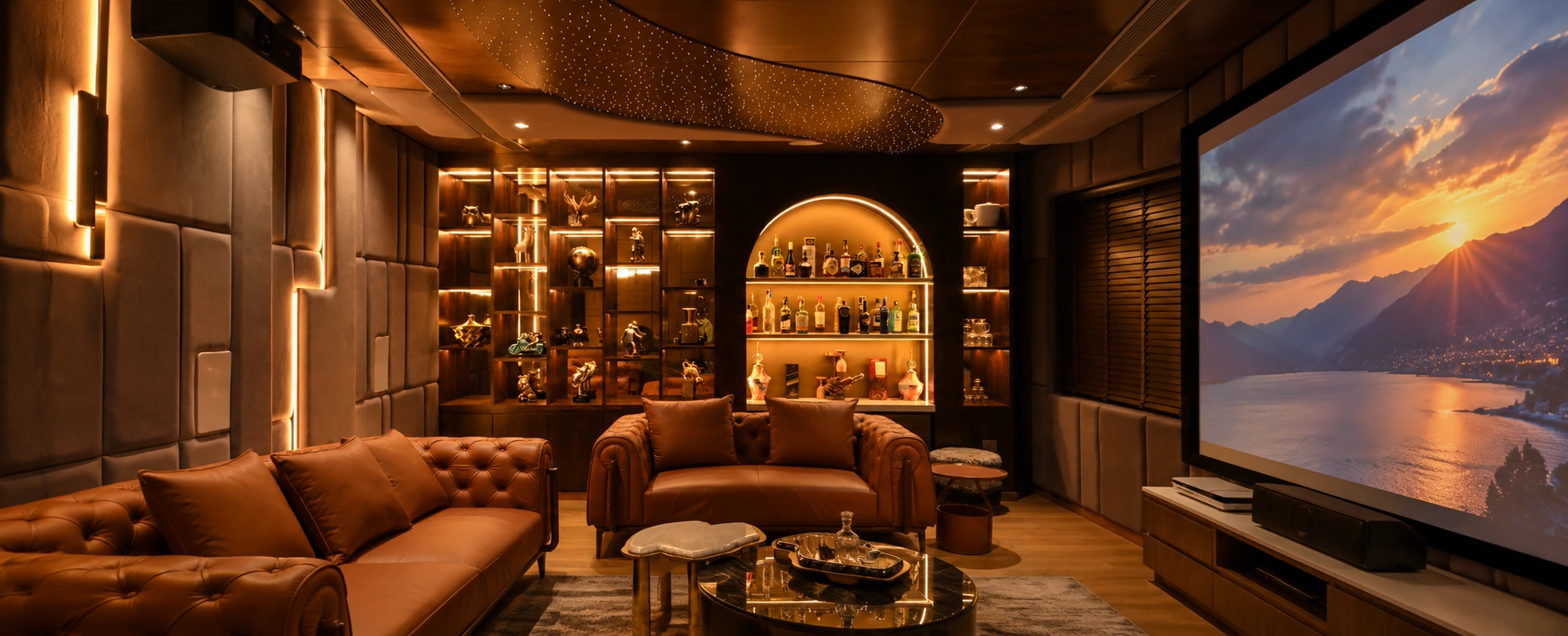
- A dedicated home cinema or media room — projector or large display, surround sound, acoustic treatment, and seating designed as a single experience. Our guides to a private luxury home cinema and building your first home theatre go deeper on the cinema itself.
- Multi-zone audio — music that follows you from the living room to the bedroom to the terrace, each zone independently controlled.
- Discreet, architectural speakers — in-ceiling, in-wall and invisible plaster-in speakers that sound full while staying out of sight. We cover the choice between architectural vs. tower speakers and hidden speakers for luxury homes.
- Video distribution — content shared cleanly across TVs and screens from a central rack, instead of a separate set-top box behind every television.
- Unified control — a single app, touch panel or keypad in place of a drawer of remotes, as we explore in one app for your whole home.
- The network backbone — a robust, well-planned home network that carries control and streaming reliably across a large footprint.
Three things make these services different in a high-end home. Scale — many rooms, several floors, indoor and outdoor areas to cover as one. Discretion — the technology is expected to perform without being seen; speakers vanish into ceilings, screens drop from recesses, racks live in a dedicated cupboard. And one way to run everything — a resident or a member of staff should be able to run the whole home from one app or one keypad scene.
We saw all three come together in a 78,500 sq ft residence we integrated recently, featured in Smart Home World. Spread over three floors with a dedicated theatre, two terraces, a garden and a pool area, it needed audio and video across the entire property — yet the brief was that the technology should stay discreet and effortless. You can read more on our audio-video service page.
Home Theatre and Multi-Room Audio Integration
The two systems most people associate with luxury AV are the home cinema and whole-home music — and both depend entirely on integration.
For the home theatre, the room is the instrument. Acoustics change how speakers sound, so a cinema is calibrated to its space, not just installed in it. Speaker placement, screen or projector choice, seating and acoustic treatment are planned together — our guide to home theatre speaker placement shows why position is as important as the speaker itself.
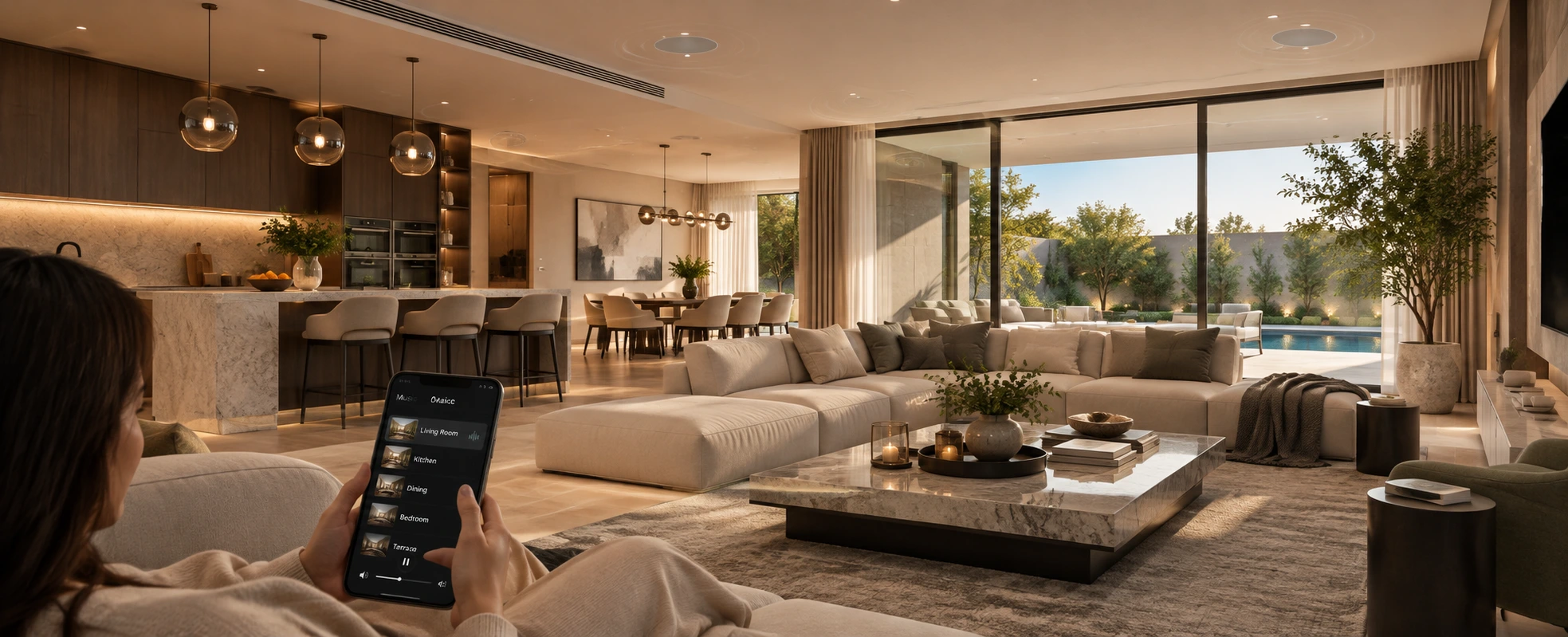
For multi-room audio, the goal is even, independent sound across the home — the living areas, bedrooms, kitchen, terrace and garden each as their own zone, all drawn from a central source and controlled from one interface. Our home audio installation guide explains how zones are planned and wired.
The thread running through both is that the wiring and decisions behind them happen long before the first speaker goes in. On the project above, pre-wiring for audio during early construction is exactly what allowed full multi-zone audio later without any civil work — the infrastructure was already there. And when extra outdoor speakers were requested after the landscaping was finished, the team added them with a discreet daisy-chain wiring solution rather than digging up finished grounds. Planning is what turns a late change from a disaster into a detail.
Integrating AV Systems with KNX Home Automation
In a truly integrated luxury home, the AV system is not an island. On an open platform like KNX, audio and video share the same control layer as lighting, curtains, and climate.
That shared layer is what makes a single "Movie" scene possible — the lights dim, the blinds close, the screen drops, and the projector powers up together, from one touch. "Good morning" can wake the home with music in the kitchen, raised blinds, and the right lighting. Because KNX is an open standard rather than a closed, single-brand system, the AV equipment, keypads, and app all speak to each other and can be extended or upgraded over time.
This is the real advantage of having one company handle both the AV and the automation: the systems are designed to work as a whole from the start. For more on how this unification works across a home, see our luxury villa automation ideas and the automation service page.
How to Choose the Right AV Integration Company
Because integration — not the equipment list — decides the outcome, the integrator you choose is the single most important decision in the project. A few things worth weighing:
- Design before install. A serious integrator produces drawings and a plan before anyone touches a cable, and designs the AV alongside the electrical and civil work.
- Open standards. Systems built on open protocols like KNX avoid locking you into one brand and stay upgradeable for years.
- Experience at your scale. A large home with many zones is a different problem from a single media room; ask to understand projects of a similar size.
- Support after handover. The relationship should not end on the day the system goes live — ongoing support is part of the value.
- A clear, honest conversation about cost. There is no fixed price for a luxury AV system; cost is driven by scope — the number of zones, whether there is a dedicated cinema, the equipment chosen, and the property size. Any figure quoted without a site survey is a guess.
We have written a dedicated, deeper guide on exactly this — how to choose the right audio-video system integrator — which is worth reading before you commit to a partner.
Why Choose Us for AV Integration?

We are a KNX-certified home and building automation integrator based in Noida, serving Delhi NCR and clients across India. We approach AV as integration first and equipment second — which shapes how we work:
- We design before we build. The AV and low-voltage layout is drawn in AutoCAD alongside the electrical drawings, so cable routes, speaker positions, rack location, and screen placements are fixed before site work begins, and conflicts are resolved on paper rather than inside a finished ceiling.
- We build on open standards. Our systems are built on KNX and open protocols, so the AV layer connects to lighting, curtains, and climate, runs from one app, and stays upgradeable.
- We work at luxury-home scale. Our recent 78,500 sq ft project — featured in Smart Home World — brought a dedicated theatre, multi-zone indoor and outdoor audio, video distribution and unified control together across three floors, while keeping the technology discreet.
- We stay after handover. The home is handed over with the family shown how to use it simply, backed by ongoing support.
If you are building or renovating and want audio and video that perform beautifully and stay invisible, the earlier the conversation starts, the better the result. Book a consultation to discuss a system designed around your home.
Frequently Asked Questions
What is an AV integration company?
An AV integration company designs, wires, and commissions all of a home's audio and video systems — home cinema, multi-zone music, TVs, projectors, speakers, and their control — so they work together as one system on a shared infrastructure, rather than as separate boxes installed room by room. In a luxury home, it also ties that AV layer into the wider automation so a single scene or app can run everything.
How is AV integration different from just buying good equipment?
Equipment is only as good as the design and wiring behind it. Integration is the planning, cabling, rack design, networking, and calibration that let premium gear perform reliably, stay hidden, and respond to one interface. Without it, you get capable devices that do not talk to each other, visible clutter, and inconsistent control — which is why integration, not the brand of a speaker, usually decides how a luxury AV system feels to live with.
When should AV integration be planned during a project?
As early as possible — ideally at the civil and electrical design stage. The most important decisions (cable routes, speaker positions, rack location, acoustic treatment, network backbone) are far cheaper and cleaner to get right before walls and ceilings close. We design the AV and low-voltage layout in AutoCAD alongside the electrical drawings so conflicts are resolved on paper, not on site.
Can speakers and screens be hidden in a luxury home?
Yes. In-ceiling and in-wall speakers, plaster-in invisible speakers, concealed subwoofers, motorised screens and recessed projectors let a room sound and look like a cinema without showing the hardware. The equipment racks are kept in a dedicated, ventilated location, and control is handled through discreet keypads, touch panels or an app — so the architecture stays clean.
Does AV integration connect to the rest of the smart home?
In a properly integrated luxury home, yes. On an open platform like KNX, the AV system shares the same control layer as lighting, curtains, and climate, so a single "Movie" scene can dim the lights, close the blinds, drop the screen, and power the projector together — and everything runs from one app rather than a drawer full of remotes.
What should I look for in an AV integration company?
Look for a partner who designs before they install, works on open standards rather than closed proprietary systems, has real experience with homes of your scale, and offers genuine after-handover support. Integration - not the equipment list - decides the outcome, so the integrator you choose is the most important decision in the project.